HomeAbout UsCapabilites
Services
Audit & Assurance
Financial Statement audit & attestationFinancial Reporting advisory
Advisory
Link 1Link 2Link 3
Tax
Link 1Link 2Link 3
Business Services & Outsourcing
Link 1Link 2Link 3

Service

Audit & Assurance

Tax & Regualtory

Advisory

Bussiness & Outsourcing

Audit & Assurance

Financial Atatement Audit & Attestation

Financial Reporting Advisory

Tax & Regualtory

Corporate Tax

Indirect Tax

Finacial Sector

Family Office,estate & succession Planing

Advisory

Mergers & acquisitions

Valuation

Due diligence

Corporate finance & investment banking

Start-up advisory

hgghhgdgfhhgd

IPO advisory

IT risk advisory & assurance

Sustainability & ESG

BFSI advisory

Management consulting

Business & Outsourcing

Finance & Accounting Outsourcing

Global Outsourcing

Compliance

Fund Accouting & Trust Accounting

Virtual CFO

Payroll

Services

Audit & Assurance
Tax & Regulatory
Advisory
Business & Outsourcing

Audit & Assurance

Financial Statement Audit & Attestation

Financial Reporting Advisory

Featured

What is the COSO framework?

September 24, 2024

Going Concern: What It Means for Your Business

August 8, 2024

Fraudulent Financial Reporting

June 19, 2024

Tax & Regulatory

Corporate Tax

Indirect Tax

Financial Sector  

Family, Office, Estate & Succession Planning

Featured

What is the COSO framework?

September 24, 2024

Going Concern: What It Means for Your Business

August 8, 2024

Fraudulent Financial Reporting

June 19, 2024

Advisory

Mergers & Acquisitions

Valuation

Due Diligence

Corporate Finance & Investment Banking

Start-up Advisory

Promoter Restructuring & Succession Planning

IPO Advisory

IT Risk Advisory & Assurance

Sustainability & ESG

BFSI Advisory

Management Consulting

Featured

What is the COSO framework?

September 24, 2024

Going Concern: What It Means for Your Business

August 8, 2024

Fraudulent Financial Reporting

June 19, 2024

Business & Outsourcing

Finance & Accounting Outsourcing

Global Outsourcing

Compliance

Fund Accounting & Trust Accounting

Virtual CFO

Payroll

Featured

What is the COSO framework?

September 24, 2024

Going Concern: What It Means for Your Business

August 8, 2024

Fraudulent Financial Reporting

June 19, 2024

Services

Services

Audit & Assurance
Tax & Regulatory
Advisory
Business & Outsourcing

Audit & Assurance

Financial Statement Audit & Attestation

Financial Reporting Advisory

Featured

What is the COSO framework?

September 24, 2024

Going Concern: What It Means for Your Business

August 8, 2024

Fraudulent Financial Reporting

June 19, 2024

Tax & Regulatory

Corporate Tax

Indirect Tax

Financial Sector  

Family, Office, Estate & Succession Planning

Featured

Invoice Management System (IMS) under GST

September 18, 2024

GST IMPORTANT ANNOUNCEMENTS via CIRCULAR NO. 230 to 233 dated. 11th Sept. 2024

September 18, 2024

GST IMPORTANT ANNOUNCEMENTS IN 54TH GST COUNCIL MEETING (September 9, 2024)

September 13, 2024

Advisory

Mergers & Acquisitions

Valuation

Due Diligence

Corporate Finance & Investment Banking

Start-up Advisory

Promoter Restructuring & Succession Planning

IPO Advisory

IT Risk Advisory & Assurance

Sustainability & ESG

BFSI Advisory

Management Consulting

Featured

Emerging Trends in AIFs: Key Regulatory Developments in FY 2025–26

February 11, 2026

TAXATION OF INFLUENCERS AND CONTENT CREATORS: THE NEW FRONTIER

June 24, 2025

Corporate Social Responsibility (CSR)

June 23, 2025

Business & Outsourcing

Finance & Accounting Outsourcing

Global Outsourcing

Compliance

Fund Accounting & Trust Accounting

Virtual CFO

Payroll

Featured

LEAVE & LAW POLICIES FOR EMPLOYEES IN INDIA

May 9, 2024

SOCIAL SECURITY LAWS- PF & ESIC

April 20, 2024

SOX Compliances

January 6, 2023

Audit & Assurance
Financial Statement Audit & AttestationFinancial Reporting Advisory
Advisory
Mergers & AcquisitionsValuationDue DiligenceCorporate Finance & Investment BankingStart-up AdvisoryPromoter Restructuring & Succession Planning IPO Advisory IT Risk Advisory & AssuranceSustainability & ESGBFSI advisoryManagement Consulting
Tax & Regulatory
Corporate TaxIndirect taxFinancial sector  Family, office, estate & succession planning
Business & Outsourcing
Finance & Accounting OutsourcingGlobal outsourcingComplianceFund accounting & Trust AccountingVirtual CFOPayroll
Solutions
Multinational CorporatesIndian CorporatesStartups
BlogsBlogsCareersContact UsContact Us
Schedule a consultation

Financial Due Diligence

By
Team Bilimoria
September 4, 2021

What is Due Diligence & Need for Due Diligence

Due diligence is the investigation or exercise of care that is normally expected to take before entering into an agreement or contract with another party so as to ensure that all risks have been disclosed and all opportunities are on the table before the commercial deal proceeds.

While due diligence may seem like it only benefits one party, the fact is that due diligence helps both the buyer and the seller in a commercial deal.

From a buyer's perspective, due diligence gives them peace of mind that they're making the right deal and have all the information they need to make a good purchasing decision. .

From a seller's perspective, due diligence helps a business owner take a deeper dive into the financial integrity of their business and can also help them uncover the fair market value of their company.


Commercial Due Diligence

Commercial due diligence is typically conducted before negotiations begin, in order to allow the potential buyer to assess the risks and potential of the target before entering in a commercial transaction deal. A Commercial Due Diligence report analyses company performance, the likelihood that the business will meet its targets, and highlights potential problems that may occur as a result of an acquisition & if the outcome of Commercial Due Diligence seems favourable & it is decided to have a commercial deal then a term sheet is agreed & Financial Due Diligence is initiated.

Financial Due Diligence

In this article, we would like to focus on Financial Due Diligence. Financial due diligence is a crucial assessment of the financial health of a business. The company’s historical and current financial performance is put under the microscope in order to establish future forecasts and identify any potential risks.
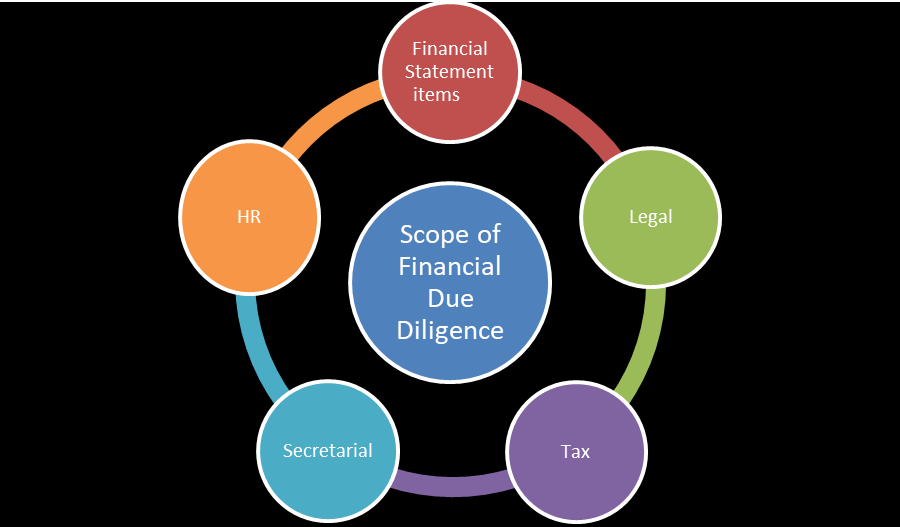

The aim is to determine whether the above points are true and accurate & helps the buy-side to get a better understanding of the company’s core performance metrics

Illustrative Points covered while conducting a Financial Due Diligence

(1) Business Overview-Details regarding the Promotors & Shareholding Pattern of the entity, its mission, initial subscribers to its MOA, BOD, Date of Incorporation etc

(2) Financial Overview-

-Items of Financial Statements-

  1. P & L items-
    1. Revenue: What contributes majorly to the revenue of the company i.e., recurring revenue & non-recurring revenue, key customers, comparability of revenue with previous years, accounting policy used for revenue recognition & segment wise analysis (customer wise, geographically, product wise etc)
    2. Cost of Goods Sold (COGS): Checking the Bill of Material (BOM) of the items, identifying the top suppliers who contribute substantially to Purchases in order to check about higher dependency on a particular supplier & if yes, looking for alternative suppliers to reduce dependency.
  • Employee Cost: To check salary register & employee wise salary details. (Covered in detail in HR DD)
  1. EBITDA: Normalisation of EBITDA- When carrying out a DD, we tend to look for sales and expenses figures which are part of the normal day-to-day operations of the business, and we expect these activities to continue when the target has been acquired. So, any items included as sales or expenses to EBITDA but which do not constitute a normal and continued day-to-day part of the business’ normal operations have to be removed from EBITDA.

  1. Cash Flow Analysis: Trend over the past years in operating, investing & financing activities to be checked.

  1. Balance-sheet items-
    1. Receivables: Ageing, key target customers to be checked.
    2. Fixed Asset: Depreciation policy followed, Physical verification to be conducted and FAR to be checked.
  • Inventory: Valuation method used, physical verification of inventory to be done.
  1. Borrowings: Details of Loan taken to be checked along with terms of repayment.
  2. Current Liabilities: Ageing for Trade Payables.
  3. Share Capital: The existing capital structure of the company to be
    checked and any changes in the share capital structure expected in future.

  • Compliances-
    1. Legal- To check whether there are any outstanding dues pending from any party, present contracts wherein future liability may arise.
    2. ROC- All ROC related compliances such as filing of Form DPT-3 (in case of loan from director), share certificates, MoM, etc are duly complied or not.
  • Tax-To check Tax returns are duly filed at the appropriate due dates or not & if late payment is done, appropriate interest or penalty is paid. Any pending assessment or notices are received from the respective authorities and to determine its outcome in future also


4) HR Due Diligence- Details of Salaries & Wages, Director Remuneration and staff welfare expenses to be checked. Also, reconciliation of number of employees joined and resigned over the years and expected attrition in future to be checked. Check the HR policies in case of resignation of employees & future hiring plans of the company.

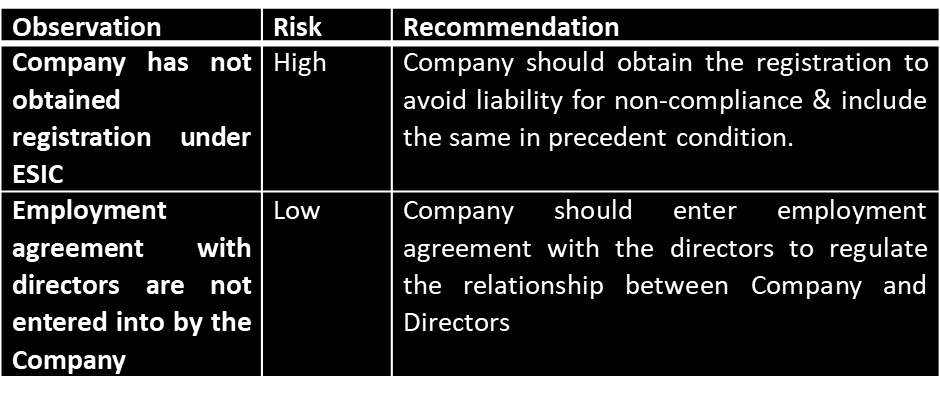
Observation Summary

Based on the Financial Due Diligence conducted, the observations along with risks & recommendations to be highlighted which is explained by way of an example as follows-
Conclusion

Post the current shift in the way of transacting, valuations and the multiple facets of the investment cycle are driven by diligence finds. An end-to-end diligence does not only throw light on the gaps and red flags, but also lends an expert eye into understanding nuances of the target better, thereby backing an informed decision-making process. With the above insights it is safe to conclude that due diligence in all its forms and scales makes for a key component of the transactional ecosystem.

In case you would like to have Due Diligence for your organization, contact us on the below-mentioned mail IDs.

CA Shreyans Dedhia
Partner, MASD
E-mail ID: shreyans.dedhia@masd.co.in

Poojan Joshi
Associate Consultant, MASD
E-mail ID: poojan.joshi@masd.co.in
Explore More

February 11, 2026

Team Bilimoria

How Artificial Intelligence Is Shaping the Future of Tax Regulation in India

Numerous financial records processed annually, lakhs of tax notices generated and thousands of crores in tax revenue collected, the complexity and scale of regulation have reached unprecedented levels. Traditional methods can no longer keep pace with such scale of data. Therefore, to deal with new emerging problems in tax regulation the tax authorities have started to integrate artificial intelligence to automate the tax operations and fundamentally redefining them. From predictive analytics that flag anomalies, to intelligent systems that auto-populate returns and resolve queries in real time, AI is reshaping the very foundation of tax regulation in India. ‍

Read More

February 11, 2026

Team Bilimoria

DEEMED EXPORTS UNDER GST

Export of goods, in common parlance, means taking goods outside India. The process of supplying the goods(produced/manufactured in the country) on an international scale is known as Export. Such supply of goods and service contribute to the growth of an economy and thus enjoy the perk of being treated as zero-rated supplies. Such supplies are treated as zero-rated supplies under GST. However, there is a certain category of supplies, as notified by the Central Government, wherein the supply is treated as an export, even if the goods do not leave the national borders. The Central Government have notified such categories of supplies of goods as deemed exports. This means that such supplies shall be treated as exports even if such goods are not taken outside India.

Read More

Read All Blogs

BILiMORIA MEHTA & CO. is a leading Chartered Accountancy firm with a rich legacy of serving clients in India and internationally.

info@bilimoriamehta.com

+91 (22) 6697-2111

Company

  • About Us
  • Contact Us
  • Careers
  • Resources

Solutions

  • for Startups
  • for Indian Corporates
  • for Multinational Clientele

Solutions

  • Multinational Corporates
  • Indian Corporates
  • Startups

Services

  • Audit & Assurance
  • Tax & Regulatory
  • Advisory
  • Business & Outsourcing

Resources

  • Blogs
  • Regulatory Updates
© 2024 BILiMORIA MEHTA & Co. All Rights Reserved
Privacy PolicyTerms & Conditions