HomeAbout UsCapabilites
Services
Audit & Assurance
Financial Statement audit & attestationFinancial Reporting advisory
Advisory
Link 1Link 2Link 3
Tax
Link 1Link 2Link 3
Business Services & Outsourcing
Link 1Link 2Link 3

Service

Audit & Assurance

Tax & Regualtory

Advisory

Bussiness & Outsourcing

Audit & Assurance

Financial Atatement Audit & Attestation

Financial Reporting Advisory

Tax & Regualtory

Corporate Tax

Indirect Tax

Finacial Sector

Family Office,estate & succession Planing

Advisory

Mergers & acquisitions

Valuation

Due diligence

Corporate finance & investment banking

Start-up advisory

hgghhgdgfhhgd

IPO advisory

IT risk advisory & assurance

Sustainability & ESG

BFSI advisory

Management consulting

Business & Outsourcing

Finance & Accounting Outsourcing

Global Outsourcing

Compliance

Fund Accouting & Trust Accounting

Virtual CFO

Payroll

Services

Audit & Assurance
Tax & Regulatory
Advisory
Business & Outsourcing

Audit & Assurance

Financial Statement Audit & Attestation

Financial Reporting Advisory

Featured

What is the COSO framework?

September 24, 2024

Going Concern: What It Means for Your Business

August 8, 2024

Fraudulent Financial Reporting

June 19, 2024

Tax & Regulatory

Corporate Tax

Indirect Tax

Financial Sector  

Family, Office, Estate & Succession Planning

Featured

What is the COSO framework?

September 24, 2024

Going Concern: What It Means for Your Business

August 8, 2024

Fraudulent Financial Reporting

June 19, 2024

Advisory

Mergers & Acquisitions

Valuation

Due Diligence

Corporate Finance & Investment Banking

Start-up Advisory

Promoter Restructuring & Succession Planning

IPO Advisory

IT Risk Advisory & Assurance

Sustainability & ESG

BFSI Advisory

Management Consulting

Featured

What is the COSO framework?

September 24, 2024

Going Concern: What It Means for Your Business

August 8, 2024

Fraudulent Financial Reporting

June 19, 2024

Business & Outsourcing

Finance & Accounting Outsourcing

Global Outsourcing

Compliance

Fund Accounting & Trust Accounting

Virtual CFO

Payroll

Featured

What is the COSO framework?

September 24, 2024

Going Concern: What It Means for Your Business

August 8, 2024

Fraudulent Financial Reporting

June 19, 2024

Services

Services

Audit & Assurance
Tax & Regulatory
Advisory
Business & Outsourcing

Audit & Assurance

Financial Statement Audit & Attestation

Financial Reporting Advisory

Featured

What is the COSO framework?

September 24, 2024

Going Concern: What It Means for Your Business

August 8, 2024

Fraudulent Financial Reporting

June 19, 2024

Tax & Regulatory

Corporate Tax

Indirect Tax

Financial Sector  

Family, Office, Estate & Succession Planning

Featured

Invoice Management System (IMS) under GST

September 18, 2024

GST IMPORTANT ANNOUNCEMENTS via CIRCULAR NO. 230 to 233 dated. 11th Sept. 2024

September 18, 2024

GST IMPORTANT ANNOUNCEMENTS IN 54TH GST COUNCIL MEETING (September 9, 2024)

September 13, 2024

Advisory

Mergers & Acquisitions

Valuation

Due Diligence

Corporate Finance & Investment Banking

Start-up Advisory

Promoter Restructuring & Succession Planning

IPO Advisory

IT Risk Advisory & Assurance

Sustainability & ESG

BFSI Advisory

Management Consulting

Featured

Emerging Trends in AIFs: Key Regulatory Developments in FY 2025–26

February 11, 2026

TAXATION OF INFLUENCERS AND CONTENT CREATORS: THE NEW FRONTIER

June 24, 2025

Corporate Social Responsibility (CSR)

June 23, 2025

Business & Outsourcing

Finance & Accounting Outsourcing

Global Outsourcing

Compliance

Fund Accounting & Trust Accounting

Virtual CFO

Payroll

Featured

LEAVE & LAW POLICIES FOR EMPLOYEES IN INDIA

May 9, 2024

SOCIAL SECURITY LAWS- PF & ESIC

April 20, 2024

SOX Compliances

January 6, 2023

Audit & Assurance
Financial Statement Audit & AttestationFinancial Reporting Advisory
Advisory
Mergers & AcquisitionsValuationDue DiligenceCorporate Finance & Investment BankingStart-up AdvisoryPromoter Restructuring & Succession Planning IPO Advisory IT Risk Advisory & AssuranceSustainability & ESGBFSI advisoryManagement Consulting
Tax & Regulatory
Corporate TaxIndirect taxFinancial sector  Family, office, estate & succession planning
Business & Outsourcing
Finance & Accounting OutsourcingGlobal outsourcingComplianceFund accounting & Trust AccountingVirtual CFOPayroll
Solutions
Multinational CorporatesIndian CorporatesStartups
BlogsBlogsCareersContact UsContact Us
Schedule a consultation

National Pension Scheme

By
Team Bilimoria
October 21, 2022

Introduction: -

The National Pension Scheme is a pension system administered and regulated by the Pension Fund Regulatory and Development Authority (PFRDA). This pension programme is available to all the employees from public, private and even the unorganized sector on a voluntary basis. For anyone who works in a private sector has an immense value of the scheme who require a regular income after their employment. This scheme encourages them to invest regularly during their course of employment, the benefits of which can be availed in the form of regular monthly pension post retirement. This scheme is transferable across jobs and locations, with tax benefits under Section 80C and Section 80CCD.

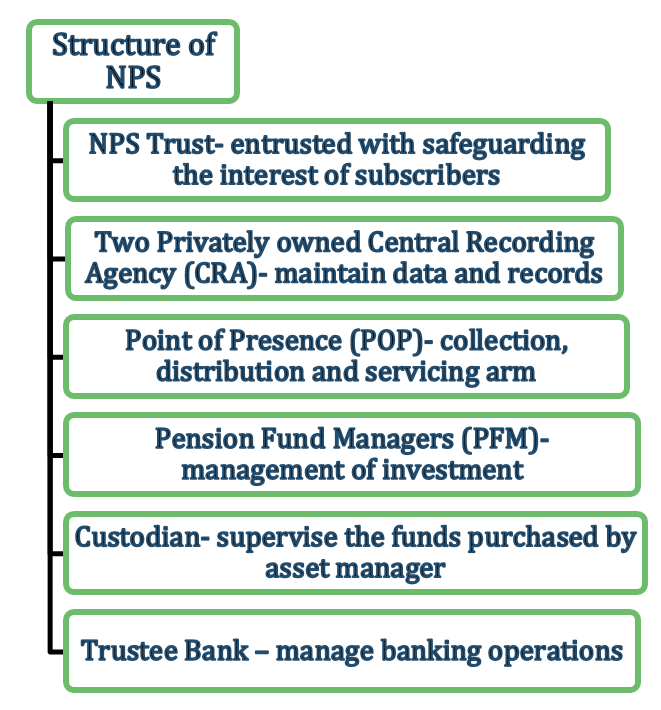
Structure of NPS:-

Contrasting to the way the traditional financial instruments work where all the functions are handled within one company, the NPS has an unbundled structure of functioning.
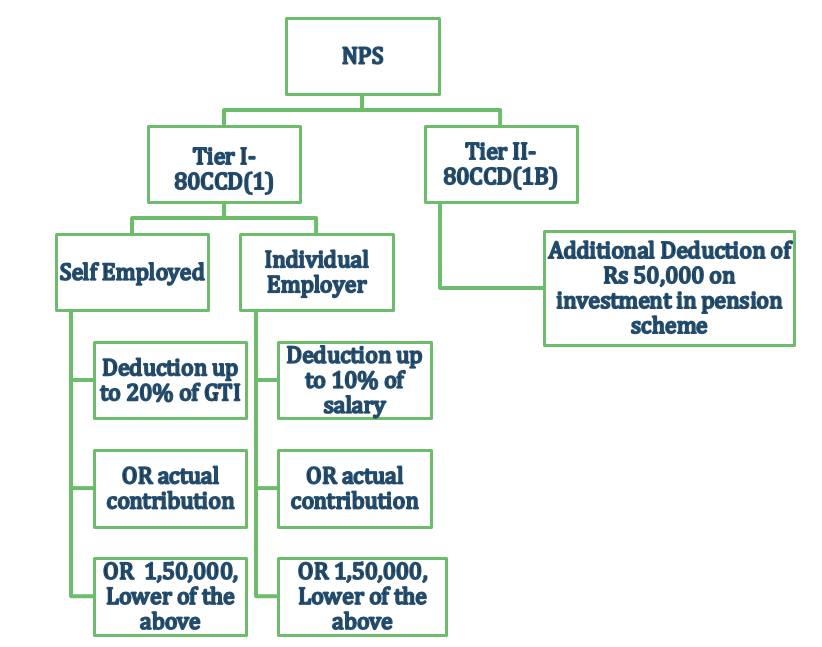
NPS – Tax Benefits: -
At the time of maturity:-

  1. Full Withdrawal
  • Employee – 60% of total is exempt
  • Self Employed – 60% of total is exempt
  1. Partial Withdrawal –
  • Employee – 25% of Employee contribution is exempt
  • Self Employed – Fully Taxable
  1. In case of death, the maturity amount is not taxable under section 80CCD (3).

Advantages of NPS: -

  1. Diversification – One of the biggest benefit of the scheme, is that, it diversifies the funds allowing the subscribers to invest in equity as well as debt market.
  2. Return on funds – the funds are managed by the professional fund managers, which ensures optimum return on the investment.
  3. Various Schemes – In NPS, there is option between, Auto choice and Active choice. Active choice allows you to select the asset allocation as per the age and risk profile. Whereas, if you are new to investments, then you can go with Auto choice. This option automatically adjusts the funds between government securities, corporate bonds, and equity as you age. There is also an option to the subscribers to switch between the two options.
  4. Convenience – Most of authorized banks facilitate online application for NPS account. The subscribers have to submit the online form along with the required documents. Once the account is opened, they will receive a 12-digit unique Permanent Retirement Account Number (PRAN), which remains same throughout life irrespective of switch in the employment.
  5. Regulations – All the investments of the NPS scheme are regulated which facilitates the subscribers to earn better returns along with security of their funds.

Disadvantages of NPS:-

  1. Withdrawal Limits – subscriber willing to make withdrawal before maturity can apply provided that he fulfils various conditions. This creates a hassle for them.
  2. Taxation at time of maturity – 60% of the maturity amount is tax free and rest is taxable. Comparing this scheme to other financial instruments whose maturity proceeds are not liable to tax, this scheme is perceived as having less advantage than those.
  3. Limit on equity investment – The scheme offers Active choice to customise the asset allocation. But it restricts the equity exposure up to certain limit. The subscribers aiming for higher returns see it as a significant drawback.

Conclusion: -

The National Pension Scheme, even though being a secure mechanism for investment has its own drawbacks which may contradict with the interest of the subscribers or may not fulfil all their requirements. Not being able withdraw their funds before maturity, limited exposure, partial taxation are some hassles which the subscribers have to face. However, most of restrictions are put in place to attain the retirement objective of the scheme.

With easy access, secure investment options, investment diversification, National Pension Scheme is a desirable investment instrument for people having requisite of regular income even after retirement.

(This article represents the views of the authors only and does not intent to give any kind of legal opinion on any matter)

Authors:

CA Hardik Patel

Partner |+919870738130|hardik.patel@masd.co.in|LinkedIn profile

Shripriya Aithal

Associate Consultant |+918779984264|shripriya.aithal@masd.co.in|LinkedIn profile
Explore More

February 11, 2026

Team Bilimoria

How Artificial Intelligence Is Shaping the Future of Tax Regulation in India

Numerous financial records processed annually, lakhs of tax notices generated and thousands of crores in tax revenue collected, the complexity and scale of regulation have reached unprecedented levels. Traditional methods can no longer keep pace with such scale of data. Therefore, to deal with new emerging problems in tax regulation the tax authorities have started to integrate artificial intelligence to automate the tax operations and fundamentally redefining them. From predictive analytics that flag anomalies, to intelligent systems that auto-populate returns and resolve queries in real time, AI is reshaping the very foundation of tax regulation in India. ‍

Read More

February 11, 2026

Team Bilimoria

DEEMED EXPORTS UNDER GST

Export of goods, in common parlance, means taking goods outside India. The process of supplying the goods(produced/manufactured in the country) on an international scale is known as Export. Such supply of goods and service contribute to the growth of an economy and thus enjoy the perk of being treated as zero-rated supplies. Such supplies are treated as zero-rated supplies under GST. However, there is a certain category of supplies, as notified by the Central Government, wherein the supply is treated as an export, even if the goods do not leave the national borders. The Central Government have notified such categories of supplies of goods as deemed exports. This means that such supplies shall be treated as exports even if such goods are not taken outside India.

Read More

Read All Blogs

BILiMORIA MEHTA & CO. is a leading Chartered Accountancy firm with a rich legacy of serving clients in India and internationally.

info@bilimoriamehta.com

+91 (22) 6697-2111

Company

  • About Us
  • Contact Us
  • Careers
  • Resources

Solutions

  • for Startups
  • for Indian Corporates
  • for Multinational Clientele

Solutions

  • Multinational Corporates
  • Indian Corporates
  • Startups

Services

  • Audit & Assurance
  • Tax & Regulatory
  • Advisory
  • Business & Outsourcing

Resources

  • Blogs
  • Regulatory Updates
© 2024 BILiMORIA MEHTA & Co. All Rights Reserved
Privacy PolicyTerms & Conditions