HomeAbout UsCapabilites
Services
Audit & Assurance
Financial Statement audit & attestationFinancial Reporting advisory
Advisory
Link 1Link 2Link 3
Tax
Link 1Link 2Link 3
Business Services & Outsourcing
Link 1Link 2Link 3

Service

Audit & Assurance

Tax & Regualtory

Advisory

Bussiness & Outsourcing

Audit & Assurance

Financial Atatement Audit & Attestation

Financial Reporting Advisory

Tax & Regualtory

Corporate Tax

Indirect Tax

Finacial Sector

Family Office,estate & succession Planing

Advisory

Mergers & acquisitions

Valuation

Due diligence

Corporate finance & investment banking

Start-up advisory

hgghhgdgfhhgd

IPO advisory

IT risk advisory & assurance

Sustainability & ESG

BFSI advisory

Management consulting

Business & Outsourcing

Finance & Accounting Outsourcing

Global Outsourcing

Compliance

Fund Accouting & Trust Accounting

Virtual CFO

Payroll

Services

Audit & Assurance
Tax & Regulatory
Advisory
Business & Outsourcing

Audit & Assurance

Financial Statement Audit & Attestation

Financial Reporting Advisory

Featured

What is the COSO framework?

September 24, 2024

Going Concern: What It Means for Your Business

August 8, 2024

Fraudulent Financial Reporting

June 19, 2024

Tax & Regulatory

Corporate Tax

Indirect Tax

Financial Sector  

Family, Office, Estate & Succession Planning

Featured

What is the COSO framework?

September 24, 2024

Going Concern: What It Means for Your Business

August 8, 2024

Fraudulent Financial Reporting

June 19, 2024

Advisory

Mergers & Acquisitions

Valuation

Due Diligence

Corporate Finance & Investment Banking

Start-up Advisory

Promoter Restructuring & Succession Planning

IPO Advisory

IT Risk Advisory & Assurance

Sustainability & ESG

BFSI Advisory

Management Consulting

Featured

What is the COSO framework?

September 24, 2024

Going Concern: What It Means for Your Business

August 8, 2024

Fraudulent Financial Reporting

June 19, 2024

Business & Outsourcing

Finance & Accounting Outsourcing

Global Outsourcing

Compliance

Fund Accounting & Trust Accounting

Virtual CFO

Payroll

Featured

What is the COSO framework?

September 24, 2024

Going Concern: What It Means for Your Business

August 8, 2024

Fraudulent Financial Reporting

June 19, 2024

Services

Services

Audit & Assurance
Tax & Regulatory
Advisory
Business & Outsourcing

Audit & Assurance

Financial Statement Audit & Attestation

Financial Reporting Advisory

Featured

What is the COSO framework?

September 24, 2024

Going Concern: What It Means for Your Business

August 8, 2024

Fraudulent Financial Reporting

June 19, 2024

Tax & Regulatory

Corporate Tax

Indirect Tax

Financial Sector  

Family, Office, Estate & Succession Planning

Featured

Invoice Management System (IMS) under GST

September 18, 2024

GST IMPORTANT ANNOUNCEMENTS via CIRCULAR NO. 230 to 233 dated. 11th Sept. 2024

September 18, 2024

GST IMPORTANT ANNOUNCEMENTS IN 54TH GST COUNCIL MEETING (September 9, 2024)

September 13, 2024

Advisory

Mergers & Acquisitions

Valuation

Due Diligence

Corporate Finance & Investment Banking

Start-up Advisory

Promoter Restructuring & Succession Planning

IPO Advisory

IT Risk Advisory & Assurance

Sustainability & ESG

BFSI Advisory

Management Consulting

Featured

Emerging Trends in AIFs: Key Regulatory Developments in FY 2025–26

February 11, 2026

TAXATION OF INFLUENCERS AND CONTENT CREATORS: THE NEW FRONTIER

June 24, 2025

Corporate Social Responsibility (CSR)

June 23, 2025

Business & Outsourcing

Finance & Accounting Outsourcing

Global Outsourcing

Compliance

Fund Accounting & Trust Accounting

Virtual CFO

Payroll

Featured

LEAVE & LAW POLICIES FOR EMPLOYEES IN INDIA

May 9, 2024

SOCIAL SECURITY LAWS- PF & ESIC

April 20, 2024

SOX Compliances

January 6, 2023

Audit & Assurance
Financial Statement Audit & AttestationFinancial Reporting Advisory
Advisory
Mergers & AcquisitionsValuationDue DiligenceCorporate Finance & Investment BankingStart-up AdvisoryPromoter Restructuring & Succession Planning IPO Advisory IT Risk Advisory & AssuranceSustainability & ESGBFSI advisoryManagement Consulting
Tax & Regulatory
Corporate TaxIndirect taxFinancial sector  Family, office, estate & succession planning
Business & Outsourcing
Finance & Accounting OutsourcingGlobal outsourcingComplianceFund accounting & Trust AccountingVirtual CFOPayroll
Solutions
Multinational CorporatesIndian CorporatesStartups
BlogsBlogsCareersContact UsContact Us
Schedule a consultation

SHRINKFLATION

By
Team Bilimoria
December 29, 2022

Introduction: -

Shrinkflation is downsizing the size of the product while maintaining the price. To define it economically, shrinkflation is the practice of retaining the price of the products, while the quantity or the size is reduced. It is a form of hidden inflation. Instead of increasing the price which becomes evident to the consumers, the quantity is reduced which offset the higher production cost of the manufacturers, saving their money in the long run. This practice is widely used by the producers in the Food and Beverage Industry. It is a common strategy used by them to help with their own inflation drawback. It also helps in deceiving consumers into believing that the brands are not affected by inflation since the quantity or the size is reduced by very small amounts. Even though the practice negatively impacts the consumer’s lives, it is not viewed as fraud or misrepresentation of products. It is just a smart tactic used by the producers to save cost.

Factors causing Shrinkflation:

  1. Higher Production Cost:

The primary cause of shrinkflation is the rise in production cost. The producer’s profit margin diminishes subsequently due to increase in cost of ingredients or raw materials, energy commodities, and labour. They reduce the quantity or size offered to consumers as a countermeasure. This strategy is applied against immediate rise in price, because consumers generally do not pay attention to minor changes in quantity. Due to this, the sales volume is also not affected.

  1. Intense Market Competition:

Fierce competition in the marketplace may also cause shrinkflation. To attract customers, the producers may maintain prices which in turn also guarantees the profit margins. We can take the example of supermarkets where they have huge competitive edge due to their large scale operations. In such circumstances they do not pass on the burden of increased cost to consumers. Due to which the only option available to small producers is to follow this strategy to retain customers by maintaining retail prices.

Impact on Consumer Sentiment: -

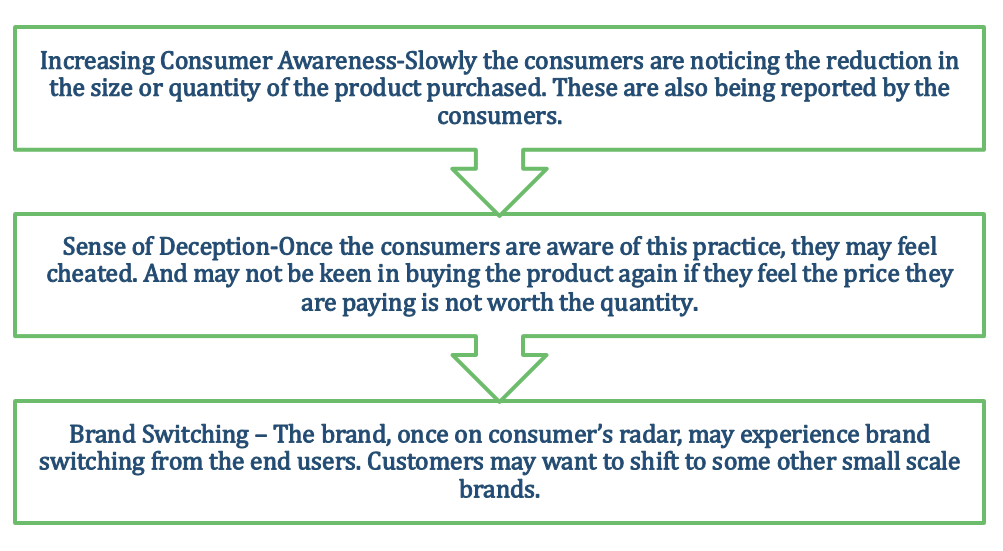
The regular consumers are not oblivious to sufficiently small reduction in the pack size. They are more deterred when there is an increase in price. This practice affects the consumer’s ability to make informed choices while buying products. The corporates also smartly deflect the consumer’s attention from the smaller packages by highlighting the message of “Less is more”. For example, claiming smaller portions leads to health benefits or environmental advantages of less packaging. The impact of such practice on consumers may be explained with the points below :
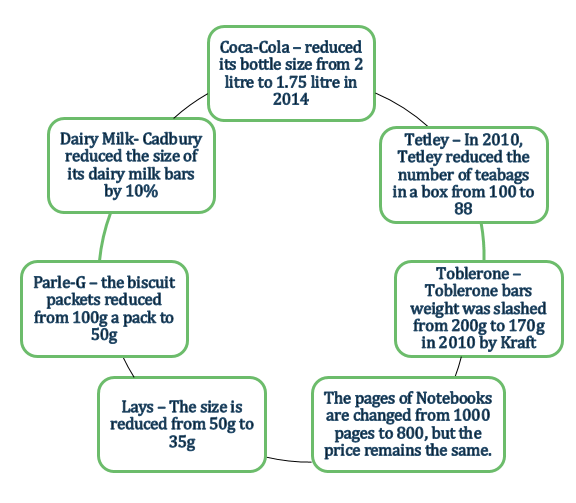
Examples of Shrinkflation:
Conclusion: -

To maintain their customer base and profitability, Shrinkflation is a useful strategy used by the producers. Most consumers won’t even notice the small changes done in the packaging of the products, but the strategy can backfire and can have adverse effects on the brand image. For example- Cadbury reduced the size of Diary milk by 10%.Earlier, the Diary milk bar was used by all for gifting purpose. But, today due to its reduction in size, it can no more be used to for the purpose. This strategy will have detrimental effect on consumer sentiments, which will lead to loss of trust and confidence of consumers in the brand. The harsh reality of shrinkflation is that, the consumers pay the same price for lesser volume and quantity.

Even though it being a powerful strategy, its use remains limited. It should be used as a last resort by the producers because its use beyond the limit can have disastrous effects on the company brand.

(This article represents the views of the authors only and does not intent to give any kind of legal opinion on any matter)

Authors:

CA Hardik Patel

Partner| +919870738130 | hardik.patel@masd.co.in |LinkedIn profile

Shripriya Aithal

Associate Consultant |+918779984264|shripriya.aithal@masd.co.in|LinkedIn profile
Explore More

February 11, 2026

Team Bilimoria

How Artificial Intelligence Is Shaping the Future of Tax Regulation in India

Numerous financial records processed annually, lakhs of tax notices generated and thousands of crores in tax revenue collected, the complexity and scale of regulation have reached unprecedented levels. Traditional methods can no longer keep pace with such scale of data. Therefore, to deal with new emerging problems in tax regulation the tax authorities have started to integrate artificial intelligence to automate the tax operations and fundamentally redefining them. From predictive analytics that flag anomalies, to intelligent systems that auto-populate returns and resolve queries in real time, AI is reshaping the very foundation of tax regulation in India. ‍

Read More

February 11, 2026

Team Bilimoria

DEEMED EXPORTS UNDER GST

Export of goods, in common parlance, means taking goods outside India. The process of supplying the goods(produced/manufactured in the country) on an international scale is known as Export. Such supply of goods and service contribute to the growth of an economy and thus enjoy the perk of being treated as zero-rated supplies. Such supplies are treated as zero-rated supplies under GST. However, there is a certain category of supplies, as notified by the Central Government, wherein the supply is treated as an export, even if the goods do not leave the national borders. The Central Government have notified such categories of supplies of goods as deemed exports. This means that such supplies shall be treated as exports even if such goods are not taken outside India.

Read More

Read All Blogs

BILiMORIA MEHTA & CO. is a leading Chartered Accountancy firm with a rich legacy of serving clients in India and internationally.

info@bilimoriamehta.com

+91 (22) 6697-2111

Company

  • About Us
  • Contact Us
  • Careers
  • Resources

Solutions

  • for Startups
  • for Indian Corporates
  • for Multinational Clientele

Solutions

  • Multinational Corporates
  • Indian Corporates
  • Startups

Services

  • Audit & Assurance
  • Tax & Regulatory
  • Advisory
  • Business & Outsourcing

Resources

  • Blogs
  • Regulatory Updates
© 2024 BILiMORIA MEHTA & Co. All Rights Reserved
Privacy PolicyTerms & Conditions