HomeAbout UsCapabilites
Services
Audit & Assurance
Financial Statement audit & attestationFinancial Reporting advisory
Advisory
Link 1Link 2Link 3
Tax
Link 1Link 2Link 3
Business Services & Outsourcing
Link 1Link 2Link 3

Service

Audit & Assurance

Tax & Regualtory

Advisory

Bussiness & Outsourcing

Audit & Assurance

Financial Atatement Audit & Attestation

Financial Reporting Advisory

Tax & Regualtory

Corporate Tax

Indirect Tax

Finacial Sector

Family Office,estate & succession Planing

Advisory

Mergers & acquisitions

Valuation

Due diligence

Corporate finance & investment banking

Start-up advisory

hgghhgdgfhhgd

IPO advisory

IT risk advisory & assurance

Sustainability & ESG

BFSI advisory

Management consulting

Business & Outsourcing

Finance & Accounting Outsourcing

Global Outsourcing

Compliance

Fund Accouting & Trust Accounting

Virtual CFO

Payroll

Services

Audit & Assurance
Tax & Regulatory
Advisory
Business & Outsourcing

Audit & Assurance

Financial Statement Audit & Attestation

Financial Reporting Advisory

Featured

What is the COSO framework?

September 24, 2024

Going Concern: What It Means for Your Business

August 8, 2024

Fraudulent Financial Reporting

June 19, 2024

Tax & Regulatory

Corporate Tax

Indirect Tax

Financial Sector  

Family, Office, Estate & Succession Planning

Featured

What is the COSO framework?

September 24, 2024

Going Concern: What It Means for Your Business

August 8, 2024

Fraudulent Financial Reporting

June 19, 2024

Advisory

Mergers & Acquisitions

Valuation

Due Diligence

Corporate Finance & Investment Banking

Start-up Advisory

Promoter Restructuring & Succession Planning

IPO Advisory

IT Risk Advisory & Assurance

Sustainability & ESG

BFSI Advisory

Management Consulting

Featured

What is the COSO framework?

September 24, 2024

Going Concern: What It Means for Your Business

August 8, 2024

Fraudulent Financial Reporting

June 19, 2024

Business & Outsourcing

Finance & Accounting Outsourcing

Global Outsourcing

Compliance

Fund Accounting & Trust Accounting

Virtual CFO

Payroll

Featured

What is the COSO framework?

September 24, 2024

Going Concern: What It Means for Your Business

August 8, 2024

Fraudulent Financial Reporting

June 19, 2024

Services

Services

Audit & Assurance
Tax & Regulatory
Advisory
Business & Outsourcing

Audit & Assurance

Financial Statement Audit & Attestation

Financial Reporting Advisory

Featured

What is the COSO framework?

September 24, 2024

Going Concern: What It Means for Your Business

August 8, 2024

Fraudulent Financial Reporting

June 19, 2024

Tax & Regulatory

Corporate Tax

Indirect Tax

Financial Sector  

Family, Office, Estate & Succession Planning

Featured

Invoice Management System (IMS) under GST

September 18, 2024

GST IMPORTANT ANNOUNCEMENTS via CIRCULAR NO. 230 to 233 dated. 11th Sept. 2024

September 18, 2024

GST IMPORTANT ANNOUNCEMENTS IN 54TH GST COUNCIL MEETING (September 9, 2024)

September 13, 2024

Advisory

Mergers & Acquisitions

Valuation

Due Diligence

Corporate Finance & Investment Banking

Start-up Advisory

Promoter Restructuring & Succession Planning

IPO Advisory

IT Risk Advisory & Assurance

Sustainability & ESG

BFSI Advisory

Management Consulting

Featured

Emerging Trends in AIFs: Key Regulatory Developments in FY 2025–26

February 11, 2026

TAXATION OF INFLUENCERS AND CONTENT CREATORS: THE NEW FRONTIER

June 24, 2025

Corporate Social Responsibility (CSR)

June 23, 2025

Business & Outsourcing

Finance & Accounting Outsourcing

Global Outsourcing

Compliance

Fund Accounting & Trust Accounting

Virtual CFO

Payroll

Featured

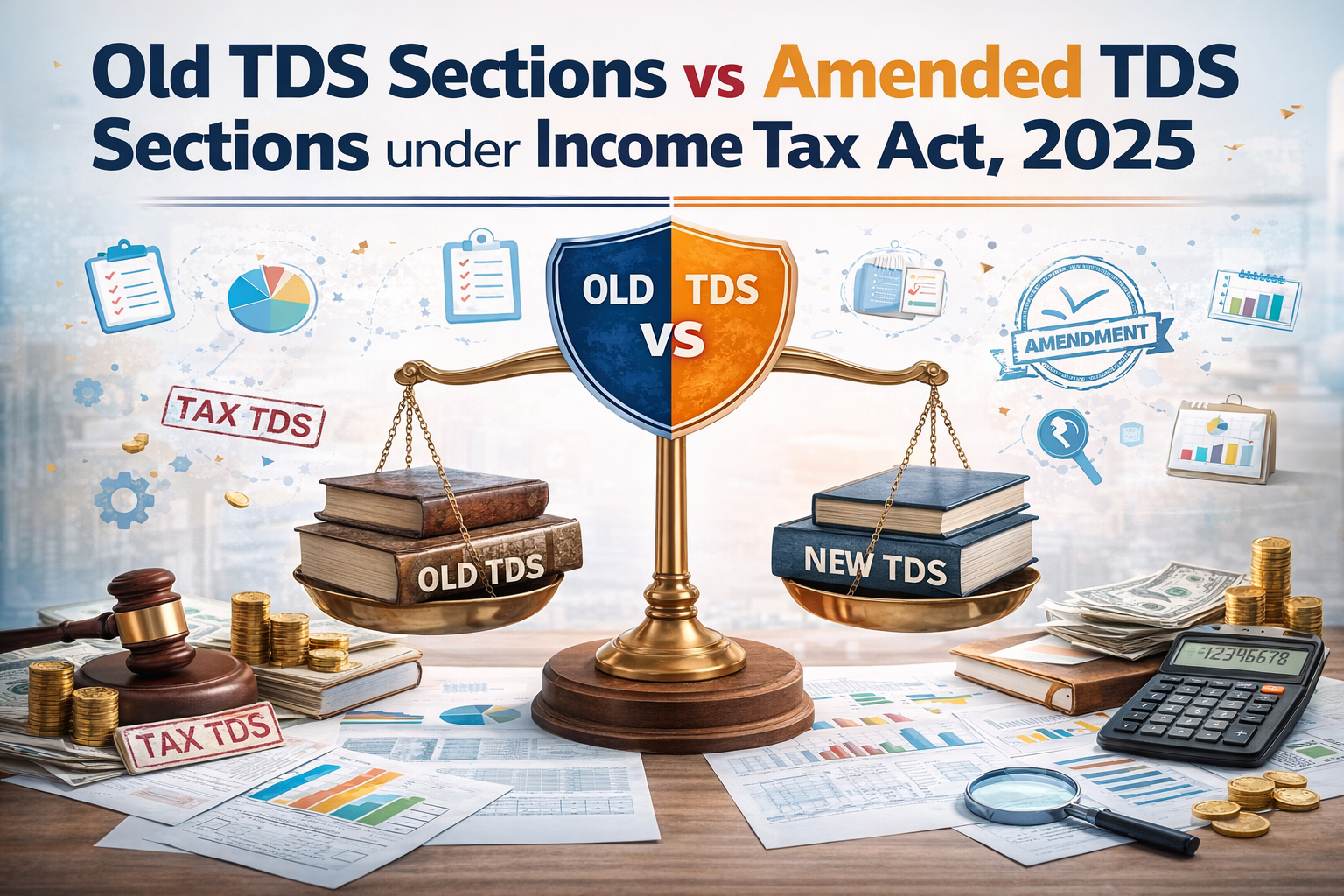
Old TDS Sections vs Amended TDS Sections under Income Tax Act, 2025

April 2, 2026

LEAVE & LAW POLICIES FOR EMPLOYEES IN INDIA

May 9, 2024

SOCIAL SECURITY LAWS- PF & ESIC

April 20, 2024

Audit & Assurance
Financial Statement Audit & AttestationFinancial Reporting Advisory
Advisory
Mergers & AcquisitionsValuationDue DiligenceCorporate Finance & Investment BankingStart-up AdvisoryPromoter Restructuring & Succession Planning IPO Advisory IT Risk Advisory & AssuranceSustainability & ESGBFSI advisoryManagement Consulting
Tax & Regulatory
Corporate TaxIndirect taxFinancial sector  Family, office, estate & succession planning
Business & Outsourcing
Finance & Accounting OutsourcingGlobal outsourcingComplianceFund accounting & Trust AccountingVirtual CFOPayroll
Solutions
Multinational CorporatesIndian CorporatesStartups
BlogsBlogsCareersContact UsContact Us
Schedule a consultation

Old TDS Sections vs Amended TDS Sections under Income Tax Act, 2025

By
Team Bilimoria
April 2, 2026

‍Introduction

Tax Deducted at Source (TDS) is a mechanism of revenue collection by Government under the income tax whereby tax is deducted at the point of generation of income rather than at a later stage. Under this system, the person responsible for making specified payments such as salary, interest, rent, commission, or professional fees is required to deduct a prescribed percentage of tax before making the payment to the recipient. The amount so deducted is then deposited with the government on behalf of the payee.

TDS provisions under the Income Tax Act, 2025 has been amended to improve compliance, widen the tax base and to simplify the process of filing the TDS. This article explains the difference between TDS sections as per Income Tax Act, 1961 and newly enacted Income Tax Act, 2025.


Objectives and Significance of TDS

The primary objective of TDS is to ensure a steady inflow of revenue to the government and to minimize tax evasion by collecting tax at the earliest point of income accrual. It also facilitates better compliance by spreading the tax liability over the financial year, reducing the burden on taxpayers at the time of filing returns. Additionally, TDS creates a transparent reporting system, as the deducted tax is reflected in the taxpayer’s records, enabling accurate tracking and reconciliation of income and taxes


Need for Reorganisation of Existing Provisions

The existing TDS framework under the Income Tax Act, 1961 required amendments due to the following key factors:
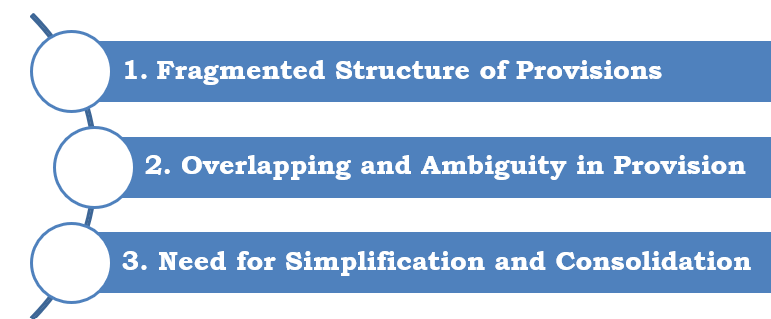
1. Fragmented Structure of Provisions

The earlier Income Tax Act, 1961 TDS consisted of multiple standalone sections, each dealing with specific types of transactions. This fragmented structure made interpretation difficult and increased the chances of errors incompliance. A consolidated framework was necessary to simplify application andimprove clarity.

2. Overlapping and Ambiguity in Provisions

Certain transactions were covered under multiple TDS sections, creatingconfusion regarding applicability. This increased the risk of incorrect deduction or duplication. A more streamlined structure was needed to eliminate overlaps and provide clear guidance.

3. Need for Simplification and Consolidation

With increasing compliance requirements, there was a strong need to simplify the TDS framework. Consolidating provisions into a single structured section improves readability and ease of implementation. This also helps businesses manage compliance more efficiently


Overview of the TDS Framework in the Newly enacted Income TaxAct, 2025 and Comparative Analysis

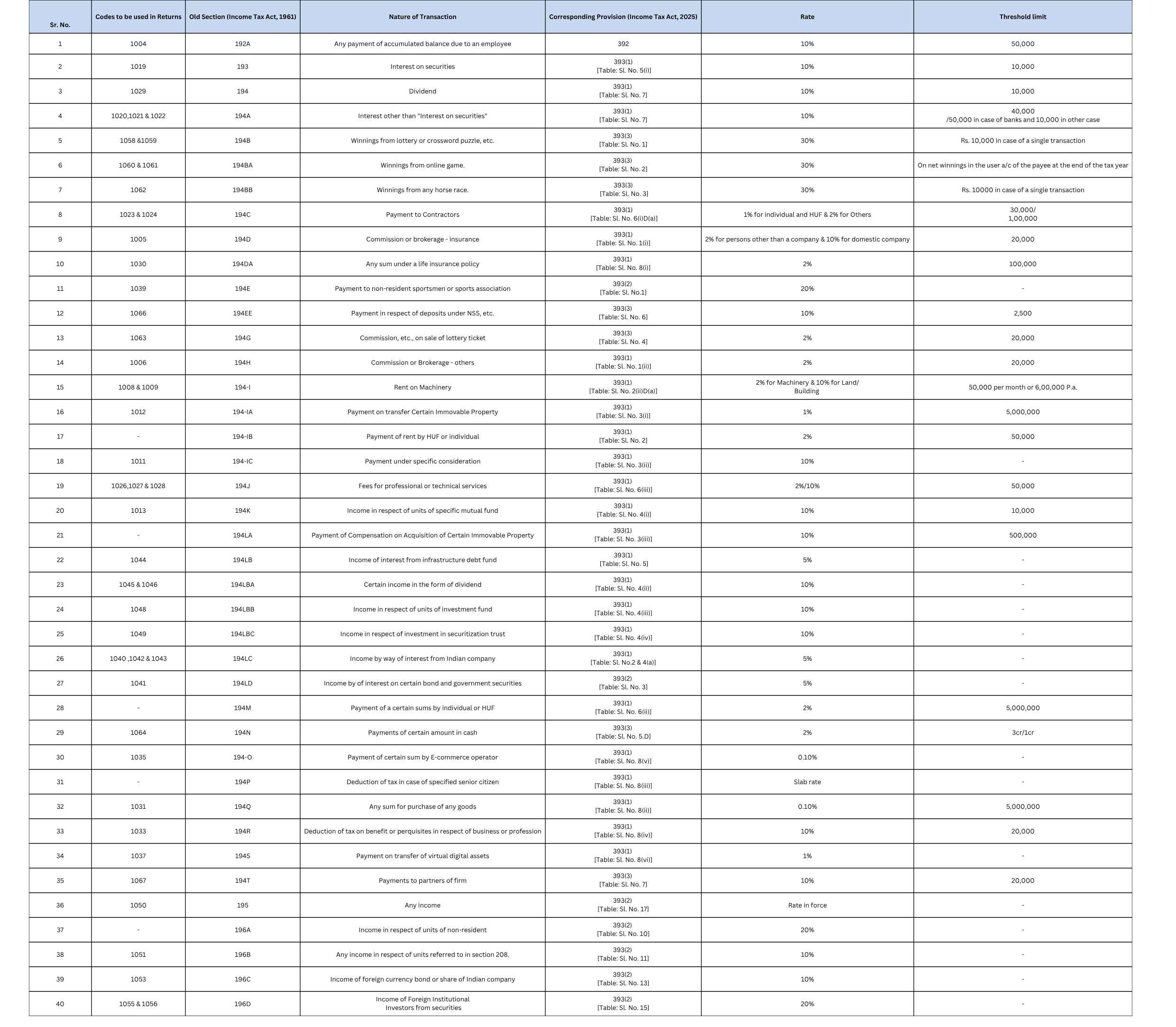
The revised TDS framework introduces a significant structural shift by consolidating multiple provisions into aunified system under Section 393. These changes have been proposed as part of the recent Income Tax Act, 2025 with the objective of simplifying and modernising the existing tax structure. This change enhances clarity, improves accessibility, and simplifies the process of identifying applicable provisionsfor various transactions.

To facilitate a better understanding of this transition, a comparative mapping of the key TDS provisions under the Income Tax Act, 1961 and the revised provisions under the Income Tax Act, 2025 hasbeen provided below. The table highlights how existing sections have beenaligned within the new structure, along with key changes in terms of scope,thresholds, and applicability. This comparison enables businesses andprofessionals to easily interpret the impact of the revised provisions andadapt their compliance processes accordingly.
 

Lower Deduction Certificate

In addition to the standard provisions relating to Tax Deducted atSource, taxpayers also have the option to apply for a lower deduction certificate where the actual tax liability is expected to be lower than the prescribed TDS rates. Under Section 395 of the Income Tax Act, 2025, an application may be made to the tax authorities in the prescribed form forobtaining such a certificate. Under the earlier framework of the Income TaxAct, 1961, such application was made in Form No. 13, whereas under the revised framework it is proposed to be made in Form No. 128, as may be notified. Upon issuance of the certificate, the payer is authorised to deduct tax at are duced rate. This mechanism helps in avoiding excess deduction of tax,improves cash flow for taxpayers, and ensures that tax is deducted moreaccurately in line with the actual liability.


Conclusion

The transition from multiple standalone TDS provisions to a consolidated framework represents a significant step towards simplifying and modernising the tax structure. By bringing various provisions under a unified system, the revised approach enhances clarity, reduces complexity, and improves ease of compliance for businesses and professionals. While the fundamental principles of Tax Deducted at Source remain unchanged, the restructured format aligns the framework with evolving business practices and emerging transaction types, thereby enabling a more efficient, transparent and streamlined tax compliance environment.


Authors:

Vishal Kothari

Partner | LinkedIn Profile |


Nitesh Jha

Manager | LinkedIn Profile |


Gaurav Gohil

Associate Consultant | LinkedIn Profile |


Ayush shah

Associate Consultant | LinkedIn Profile |


For Inquiries:

Email: https://bilimoriamehta.in/blogs/ |

Contact: +91 9320614111|
Explore More

February 11, 2026

Team Bilimoria

How Artificial Intelligence Is Shaping the Future of Tax Regulation in India

Numerous financial records processed annually, lakhs of tax notices generated and thousands of crores in tax revenue collected, the complexity and scale of regulation have reached unprecedented levels. Traditional methods can no longer keep pace with such scale of data. Therefore, to deal with new emerging problems in tax regulation the tax authorities have started to integrate artificial intelligence to automate the tax operations and fundamentally redefining them. From predictive analytics that flag anomalies, to intelligent systems that auto-populate returns and resolve queries in real time, AI is reshaping the very foundation of tax regulation in India. ‍

Read More

February 11, 2026

Team Bilimoria

DEEMED EXPORTS UNDER GST

Export of goods, in common parlance, means taking goods outside India. The process of supplying the goods(produced/manufactured in the country) on an international scale is known as Export. Such supply of goods and service contribute to the growth of an economy and thus enjoy the perk of being treated as zero-rated supplies. Such supplies are treated as zero-rated supplies under GST. However, there is a certain category of supplies, as notified by the Central Government, wherein the supply is treated as an export, even if the goods do not leave the national borders. The Central Government have notified such categories of supplies of goods as deemed exports. This means that such supplies shall be treated as exports even if such goods are not taken outside India.

Read More

Read All Blogs

BILiMORIA MEHTA & CO. is a leading Chartered Accountancy firm with a rich legacy of serving clients in India and internationally.

info@bilimoriamehta.com

+91 (22) 6697-2111

Company

  • About Us
  • Contact Us
  • Careers
  • Resources

Solutions

  • for Startups
  • for Indian Corporates
  • for Multinational Clientele

Solutions

  • Multinational Corporates
  • Indian Corporates
  • Startups

Services

  • Audit & Assurance
  • Tax & Regulatory
  • Advisory
  • Business & Outsourcing

Resources

  • Blogs
  • Regulatory Updates
© 2024 BILiMORIA MEHTA & Co. All Rights Reserved
Privacy PolicyTerms & Conditions