HomeAbout UsCapabilites
Services
Audit & Assurance
Financial Statement audit & attestationFinancial Reporting advisory
Advisory
Link 1Link 2Link 3
Tax
Link 1Link 2Link 3
Business Services & Outsourcing
Link 1Link 2Link 3

Service

Audit & Assurance

Tax & Regualtory

Advisory

Bussiness & Outsourcing

Audit & Assurance

Financial Atatement Audit & Attestation

Financial Reporting Advisory

Tax & Regualtory

Corporate Tax

Indirect Tax

Finacial Sector

Family Office,estate & succession Planing

Advisory

Mergers & acquisitions

Valuation

Due diligence

Corporate finance & investment banking

Start-up advisory

hgghhgdgfhhgd

IPO advisory

IT risk advisory & assurance

Sustainability & ESG

BFSI advisory

Management consulting

Business & Outsourcing

Finance & Accounting Outsourcing

Global Outsourcing

Compliance

Fund Accouting & Trust Accounting

Virtual CFO

Payroll

Services

Audit & Assurance
Tax & Regulatory
Advisory
Business & Outsourcing

Audit & Assurance

Financial Statement Audit & Attestation

Financial Reporting Advisory

Featured

What is the COSO framework?

September 24, 2024

Going Concern: What It Means for Your Business

August 8, 2024

Fraudulent Financial Reporting

June 19, 2024

Tax & Regulatory

Corporate Tax

Indirect Tax

Financial Sector  

Family, Office, Estate & Succession Planning

Featured

What is the COSO framework?

September 24, 2024

Going Concern: What It Means for Your Business

August 8, 2024

Fraudulent Financial Reporting

June 19, 2024

Advisory

Mergers & Acquisitions

Valuation

Due Diligence

Corporate Finance & Investment Banking

Start-up Advisory

Promoter Restructuring & Succession Planning

IPO Advisory

IT Risk Advisory & Assurance

Sustainability & ESG

BFSI Advisory

Management Consulting

Featured

What is the COSO framework?

September 24, 2024

Going Concern: What It Means for Your Business

August 8, 2024

Fraudulent Financial Reporting

June 19, 2024

Business & Outsourcing

Finance & Accounting Outsourcing

Global Outsourcing

Compliance

Fund Accounting & Trust Accounting

Virtual CFO

Payroll

Featured

What is the COSO framework?

September 24, 2024

Going Concern: What It Means for Your Business

August 8, 2024

Fraudulent Financial Reporting

June 19, 2024

Services

Services

Audit & Assurance
Tax & Regulatory
Advisory
Business & Outsourcing

Audit & Assurance

Financial Statement Audit & Attestation

Financial Reporting Advisory

Featured

What is the COSO framework?

September 24, 2024

Going Concern: What It Means for Your Business

August 8, 2024

Fraudulent Financial Reporting

June 19, 2024

Tax & Regulatory

Corporate Tax

Indirect Tax

Financial Sector  

Family, Office, Estate & Succession Planning

Featured

Invoice Management System (IMS) under GST

September 18, 2024

GST IMPORTANT ANNOUNCEMENTS via CIRCULAR NO. 230 to 233 dated. 11th Sept. 2024

September 18, 2024

GST IMPORTANT ANNOUNCEMENTS IN 54TH GST COUNCIL MEETING (September 9, 2024)

September 13, 2024

Advisory

Mergers & Acquisitions

Valuation

Due Diligence

Corporate Finance & Investment Banking

Start-up Advisory

Promoter Restructuring & Succession Planning

IPO Advisory

IT Risk Advisory & Assurance

Sustainability & ESG

BFSI Advisory

Management Consulting

Featured

Emerging Trends in AIFs: Key Regulatory Developments in FY 2025–26

February 11, 2026

TAXATION OF INFLUENCERS AND CONTENT CREATORS: THE NEW FRONTIER

June 24, 2025

Corporate Social Responsibility (CSR)

June 23, 2025

Business & Outsourcing

Finance & Accounting Outsourcing

Global Outsourcing

Compliance

Fund Accounting & Trust Accounting

Virtual CFO

Payroll

Featured

LEAVE & LAW POLICIES FOR EMPLOYEES IN INDIA

May 9, 2024

SOCIAL SECURITY LAWS- PF & ESIC

April 20, 2024

SOX Compliances

January 6, 2023

Audit & Assurance
Financial Statement Audit & AttestationFinancial Reporting Advisory
Advisory
Mergers & AcquisitionsValuationDue DiligenceCorporate Finance & Investment BankingStart-up AdvisoryPromoter Restructuring & Succession Planning IPO Advisory IT Risk Advisory & AssuranceSustainability & ESGBFSI advisoryManagement Consulting
Tax & Regulatory
Corporate TaxIndirect taxFinancial sector  Family, office, estate & succession planning
Business & Outsourcing
Finance & Accounting OutsourcingGlobal outsourcingComplianceFund accounting & Trust AccountingVirtual CFOPayroll
Solutions
Multinational CorporatesIndian CorporatesStartups
BlogsBlogsCareersContact UsContact Us
Schedule a consultation

ALL ABOUT UPDATED RETURN

By
Team Bilimoria
March 25, 2022

Introduction:-

A New Section 140B has been inserted in Direct Taxation by Finance Minister in the Budget 2022 for the tax to be paid to file a return under the proposed provisions i.e. Section 139(8A) of Income Tax Act. As per this new clause, a Taxpayer will be allowed to file an “Updated Return” to file Pending Return or correct the Omissions and Errors that are reported in the Original Return. The Time limit for filing the Updated Return is within two years from the end of relevant Assessment year.

Example: - The due date for filing Updated Return for F.Y.2022-23 i.e. A.Y.2023-24 will be 31st March, 2026.

The above amendment will come into effect from 1st April, 2022.

Eligibility:-
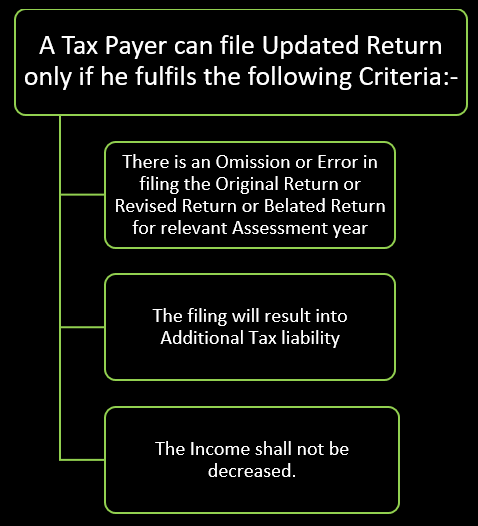
Restrictions:-

A Tax Payer shall be restricted from filing Updated Return as per Section 139(8A) if:-

  1. The updated return has been furnished for the relevant assessment year, OR
  2. If there is any on-going or completed proceeding for Assessment or Reassessment or Recomputation or Revision of Income under Income Tax Act for relevant Assessment Year, OR
  3. The Assessing Officer has information in respect of the Tax Payer for the relevant Assessment Year in his possession under the Prevention of Money Laundering Act, 2002 or the Black Money ( Undisclosed Foreign Income and Assets ) and Imposition of Tax Act, 2015 or the Provision of Benami Property Transaction Act, 1998 or The Smugglers and Foreign Exchange Manipulators (Forfeiture of Property) Act, 1976 and the same has been communicated to the Tax Payer prior to the date of filing the Updated Return, OR
  4. If any information for the relevant Assessment Year under section 90 or 90A(DTAA) has come to the notice of Assessing Officer and the same has been communicated to the Tax payer before filing of Updated Return, OR
  5. If any proceeding for Offences or Prosecution under Income Tax Act, 1961 have been initiated for the relevant Assessment Year prior to filing the Updated Return, OR
  6. If he is such other person, as may be notified by the Board in this regard.

Penalties For Filing Updated Return:-

The Penalties for filing Updated return depends upon the period in which it is filed. This can be understood from the following:-

  1. If the return is filed within 12 months from the end of relevant Assessment Year, the Taxpayer would be liable to pay a penalty which will be equal to 25% of total tax to be paid in updated return and interest thereon OR
  2. If the return is filed after 12 months but before completion of 24 months from the end of relevant Assessment Year, the Taxpayer would be liable to pay a penalty which will be equal to 50% of total tax to be paid in updated return and interest thereon.

Difference between Updated Return and Revised return:-
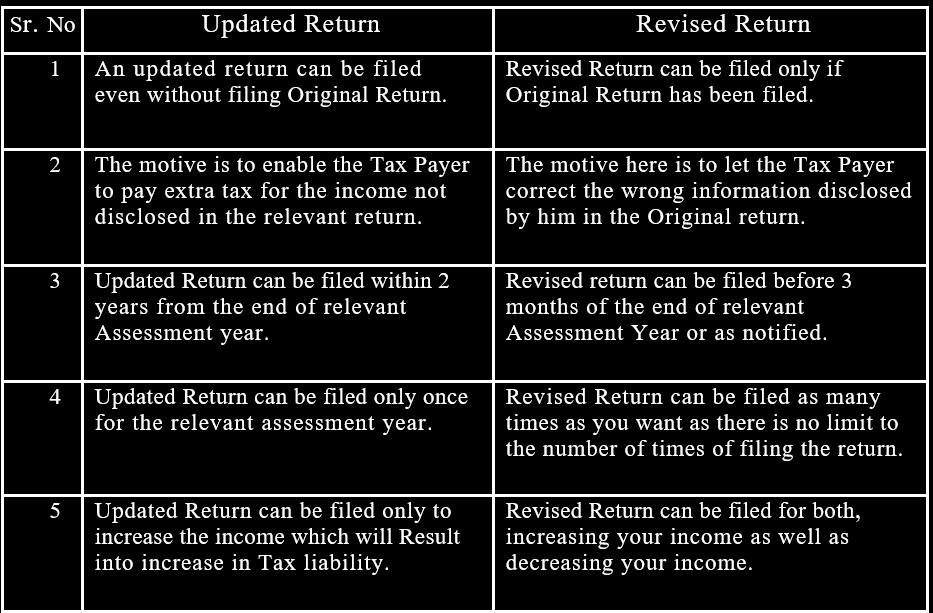
Points to be taken in Consideration while filing Updated Return:-

  1. In view of the proposed Sub-Section (8A) of section 139, New Section 140B, consequential amendments in Section 144 (Scrutiny Assessment), Section 153 (Assessment in case of Search and Seizure), Section 234A (Interest for delay in Filing return), Section 234B and 234C (Interest related to Payment of Advance Tax) and 276CC (Imprisonment in case of failure in filing the return) have also been made.
  2. A Taxpayer shall keep in mind that he won’t be eligible for any refund if opting for Updated Return.
  3. While filing Updated Return, the Interest and Late fees will be applicable as it is in normal cases, but it will also include an additional liability which is mentioned above under the Penalties head.

Objective of Introducing Updated Return:-

  1. To enable the Tax Payer to file return even if the dates have been passed, by giving extra time to file.
  2. If the Tax Payer has missed out the disclosure of certain Income which might result in proceedings then he can file the updated return in order to escape from getting into the compliance work of proceedings.
  3. The Updated return will not only save a Tax Payer from Proceedings, but also from any consecutive types of litigation
  4. If the Tax payer has missed out to file an Income Tax return of 2 years back from applicable Assessment Year, then he can still file it in the form of updated return.
  5. The Updated Return will enable the Government to have a proper knowledge on the potentiality of the income which can be generated by a Tax Payer.
  6. The Updated Return will work as a source of Additional Tax Income for the Government.
  7. By means of Updated Return, the Plan of the Government to terminate the Tax Evasion will get a kick-start.

Note: - The Information provided above is as per the Finance Bill which was introduced during the Budget 2022. The Finance Act is yet to come, so changes may be expected with relation to the Finance Act, 2022.

(This article represents the views of the authors only and does not intent to give any kind of legal opinion on any matter)

Authors:

Kushal Mehta

Associate Consultant | +919930612247 | kushal.mehta@masd.co.in

Mihir Jain

Associate Consultant | +919821700600 | mihir.jain@masd.co.in
Explore More

February 11, 2026

Team Bilimoria

How Artificial Intelligence Is Shaping the Future of Tax Regulation in India

Numerous financial records processed annually, lakhs of tax notices generated and thousands of crores in tax revenue collected, the complexity and scale of regulation have reached unprecedented levels. Traditional methods can no longer keep pace with such scale of data. Therefore, to deal with new emerging problems in tax regulation the tax authorities have started to integrate artificial intelligence to automate the tax operations and fundamentally redefining them. From predictive analytics that flag anomalies, to intelligent systems that auto-populate returns and resolve queries in real time, AI is reshaping the very foundation of tax regulation in India. ‍

Read More

February 11, 2026

Team Bilimoria

DEEMED EXPORTS UNDER GST

Export of goods, in common parlance, means taking goods outside India. The process of supplying the goods(produced/manufactured in the country) on an international scale is known as Export. Such supply of goods and service contribute to the growth of an economy and thus enjoy the perk of being treated as zero-rated supplies. Such supplies are treated as zero-rated supplies under GST. However, there is a certain category of supplies, as notified by the Central Government, wherein the supply is treated as an export, even if the goods do not leave the national borders. The Central Government have notified such categories of supplies of goods as deemed exports. This means that such supplies shall be treated as exports even if such goods are not taken outside India.

Read More

Read All Blogs

BILiMORIA MEHTA & CO. is a leading Chartered Accountancy firm with a rich legacy of serving clients in India and internationally.

info@bilimoriamehta.com

+91 (22) 6697-2111

Company

  • About Us
  • Contact Us
  • Careers
  • Resources

Solutions

  • for Startups
  • for Indian Corporates
  • for Multinational Clientele

Solutions

  • Multinational Corporates
  • Indian Corporates
  • Startups

Services

  • Audit & Assurance
  • Tax & Regulatory
  • Advisory
  • Business & Outsourcing

Resources

  • Blogs
  • Regulatory Updates
© 2024 BILiMORIA MEHTA & Co. All Rights Reserved
Privacy PolicyTerms & Conditions